The Table-Tennis Doubles Myth: Four Players Do Not Mean Four Independent Turns
Table-tennis doubles runs on a fixed hitting order, not casual partner rotation. Learn how the sequence shapes movement, tactics, and practice.
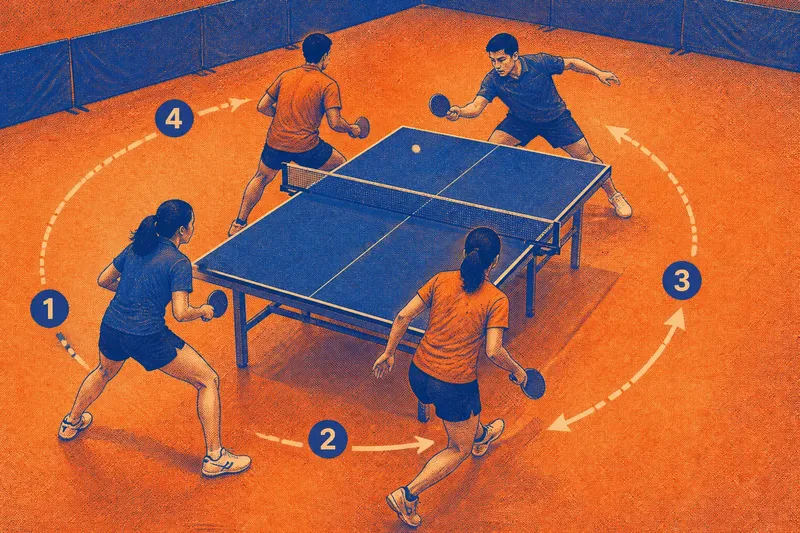
In table-tennis doubles, a player cannot simply return the ball because it is on their side: partners must alternate hits, and the serving order sets the sequence. That rule makes doubles a coordinated pattern rather than four players taking independent turns. Once the pattern is clear, the quick sidesteps and partner handoffs begin to make sense.
What does the doubles order require?
Within each team, the two partners take turns striking the ball. If A serves to C, the return belongs to C; A’s partner B must play the next shot, followed by D, then A, then C. The order continues for the rally, regardless of who has moved nearest to the ball.
That is the detail behind the common myth. Doubles is not a free-for-all in which either partner may hit whenever convenient, nor does a pair alternate only on serves. The sequence applies throughout each rally.
At the start of a game, the serving team chooses its first server, and the receiving team chooses its first receiver. The serve must travel diagonally, from the server’s right half-court to the receiver’s right half-court. After the serve and return, the partners’ alternating hitting order takes over.
How does the sequence shape movement?
Because a player has to clear space for their partner’s next hit, doubles movement often looks like a small, fast choreography. A common rhythm is to strike the ball, move out of the partner’s path, and prepare to come back into position. The precise footwork varies with the shot and the players’ styles, but both partners need an exit route.
Standing side by side can leave one player trapped behind the other. Crowding the table can make the next required hitter reach around a partner; retreating without coordination can leave the short ball exposed. Partners benefit from agreeing on a simple movement pattern before a match, then adjusting it as the rally demands.
Imagine two beginners, Maya and Luis, practicing on a marked table. Maya serves, Luis’s opponent returns, and Luis prepares to hit; after his shot, he steps aside so Maya can move into the next position. If they keep that sequence in mind, they can see whether the handoff is smooth or whether one player blocks the other, without treating every collision as a mystery of reflexes.
How can a pair learn the rhythm over a week?
A few short sessions can teach the order more clearly than a long practice spent trying to win points. The goal is not to perfect a single formation; it is to recognize whose turn it is and make room for that player.
- First session: Say the four-player order aloud during gentle rallies. Pause when someone hits out of turn, reset, and restart from the serve.
- Next session: Practice serve and receive patterns. Each player should know who serves first, who receives first, and who is due to strike the next ball after the return.
- Midweek: Add movement at an easy pace. After each shot, have the hitter clear the partner’s route rather than watching the ball from the middle of the table.
- Later in the week: Play short practice games and keep the same order through rallies. Between games, discuss one moment when a partner was unsure whose turn it was.
- Before a match: Confirm the pair’s serving and receiving choices, then agree on a brief call or gesture for awkward balls. Keep it simple enough to use under pressure.
Do not spend practice trying to choreograph every possible bounce or invent elaborate signals. A shared order and clear space solve the central coordination problem; overplanning can distract from watching the ball.
What changes after each pair of points?
The service rotation adds another layer to the hitting order. Under standard table-tennis rules, each player serves for two points in succession before service passes to the opposing pair, then the partners’ service turns continue in sequence. At deuce, the service changes after each point instead.
When service changes, the player who served becomes the receiver, and the player who received becomes the server. This rotation preserves the required alternation, but it can surprise a pair that remembers only the current score. Before a game, it helps to identify the order of both partners rather than relying on a last-second guess.
Which doubles questions come up most often?
Can either partner hit the ball next?
No. The next shot belongs to the partner whose turn follows in the fixed sequence, even if the other player is closer. If the wrong player hits, the rally is lost under the rules.
Does the serve have to cross the table diagonally?
Yes. In doubles, the serve travels from the server’s right half-court to the receiver’s right half-court. A serve landing elsewhere is not a valid doubles serve.
Who chooses the first server and receiver?
Each team chooses its own player for that role at the start of the game. The subsequent service and receiving rotation determines how those roles change as play continues.
Does the order change in every game?
Players can choose a different initial arrangement for a new game, but the required alternation still applies within that game. Match procedures can vary by competition, so players should follow the applicable rules and event instructions.
Why does the rule matter to doubles culture?
The alternating hit is more than a technical restriction: it gives each partner a responsibility on every rally. A strong doubles pair does not merely divide the table into two territories. Each player must read the developing point, trust the other to take the next shot, and move in a way that keeps the partnership alive.
That is why table-tennis doubles feels different from singles even when the ball travels at the same speed. The partners share each rally through a fixed sequence, and their movement makes that sequence visible. Remember the order, agree on how to clear space, and the supposed four-person free-for-all becomes a genuinely shared game.